
Sunday Morning Coffee — May 3, 2026 — I’m In. Pete Isn’t.
By Roy Berger, Las Vegas, NV
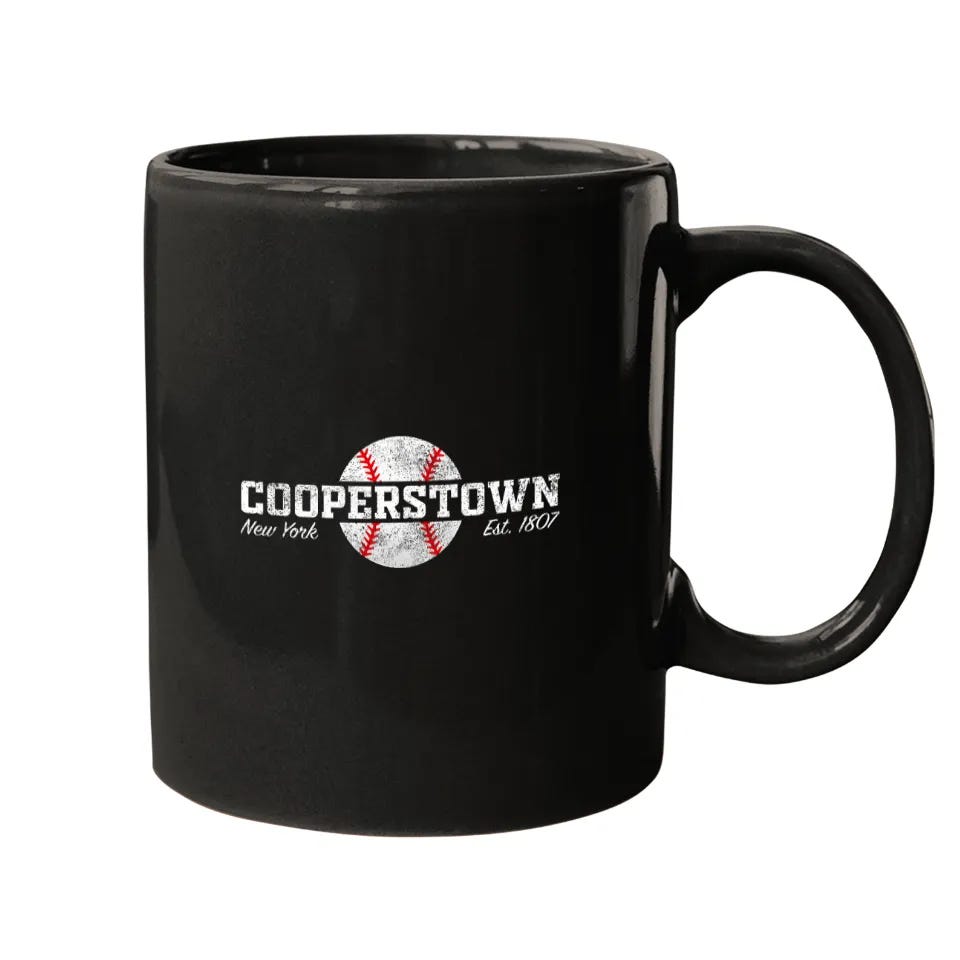
Two weeks ago, I did something Pete Rose couldn’t—I got into the National Baseball Hall of Fame.
The late Mr. Rose played 3,562 more major league games than I did; he had 4,256 more hits than me but let’s not let trivial details get in the way. I got in. He hasn’t.
And yes, it took me a while. Three weeks before turning 74, this lifelong baseballer, despite being raised only 219 miles from its front door, finally made the journey to the sport’s holy grail in Cooperstown, New York.
I figured it was time before the ticking clock runs down any further. Along with me was my son Jason who somehow went astray and is now a Dodgers fan. Maybe living in LA for twenty years does that to a guy. Jason, formerly a television writer and executive producer, is now in the sports card memorabilia business, a much more stable profession. He was the top draft pick to accompany me.
There are easier places to get to in this country, this side of Cascade, Iowa, than Cooperstown. Start by finding a flight to Albany, NY. Grab a car and drive 70 non-interstate highway miles, some two-lane road, through acres and acres of pretty countryside and farms. As you approach Cooperstown your eyes get transfixed on beautiful Lake Otsego. You enter Cooperstown right on Main Street where all the action is. Drive past the Hall of Fame building and honestly, I got chills. It’s a place revered all my life and there it was just to my left.
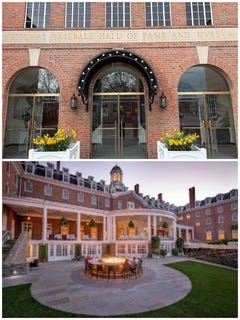
Continue another quarter mile on Main past all the baseball card shops, souvenir stores, baseball memorabilia outposts, coffee houses, a pizza joint, an Italian restaurant and a few pubs, all neighbors of the Hall. Make a right onto Lake Street and our accommodation for the night, the Otesaga Resort Hotel, stood stately. Opened in 1909, as you drive up the elegant driveway the structure exudes charm and history. It’s even better looking on the inside. Its 135 guest rooms sit right on Lake Otsego. You can see the first and last holes of the much in demand Leatherstocking Golf Course. It’s just about impossible to get a hotel booking at the Otesaga between Memorial and Labor Day, the high season in Cooperstown.
The Otesaga is an easy half-mile walk back to Main Street and the star of the show- the National Baseball Hall of Fame and Museum. And don’t think for a minute the Hall isn’t the economic driver of the village. Cooperstown has 2,200 residents; the HOF draws over 300,000 visitors to the town named after William Cooper who founded the settlement in the 1780’s. His son, famous novelist James Fenimore Cooper, immortalized the region in his writings.
Lore has it, though probably not factual, that the game of baseball was first played in Cooperstown by Abner Doubleday and his buddies. Doubleday was a career US Army officer and a Union major general in the Civil War. He was born in 1819 just outside of Cooperstown; he died in 1893. Somehow 15 years after his death, in 1908, Major Doubleday was credited with inventing the game that 118 years later the Mets still can’t play very well. Truth is the sport probably originated in the U.K. as a game called Rounders, brought to the States and soon after became our national pastime. However, a tribute to Doubleday stands tall in Cooperstown, a couple of hundred yards away from the HOF building as Abner Doubleday Field, a simple ballpark steeped in tradition and in action with organized youth games all summer.
The Doubleday legacy was enough for the baseball gods to establish the Hall of Fame and Museum in Cooperstown, as an independent, non-profit educational institution not directly owned nor operated by MLB but instead governed by a Board of Directors. It first opened to everyone but Pete Rose in 1936. The day Jason and I were there, April 15, the doors opened at 9 am. We went in before the clock hit 9:01. Having 4,256 career base hits may not be enough to get you in but $35 will. Instead, we upped the ante to $300 for a private 90-minute guided tour. Ours lasted over two hours as our guide, David, didn’t want to stop and we certainly didn’t keep looking at our watches. The $300 also made me a HOF member for a year, got me a membership card, a shiny button I’ll never wear and an incessant amount of daily promotional emails.
The word I use to describe the HOF visit is ‘overwhelming.’ Three floors for the public to explore; over 50,000 square feet with 16,000 of those dedicated to the Gallery where all the inductees’ bronze plaques are on display. There are 354 HOF members and 355 plaques. Pete Rose is not one of them. Three more will be added in July: Carlos Beltran, Andruw Jones and Jeff Kent. The first class to be inducted in 1936 consisted of Ty Cobb, Babe Ruth, Honus Wagner, Christy Mathewson and Walter Johnson. Not a bad pick-up squad.
So much to see. A typical visit to the Hall’s museum lasts about 90 minutes. We were there for four hours and would still be going if we didn’t have to get back to Albany for a two-and-a-half-hour train south along the Hudson to NYC.
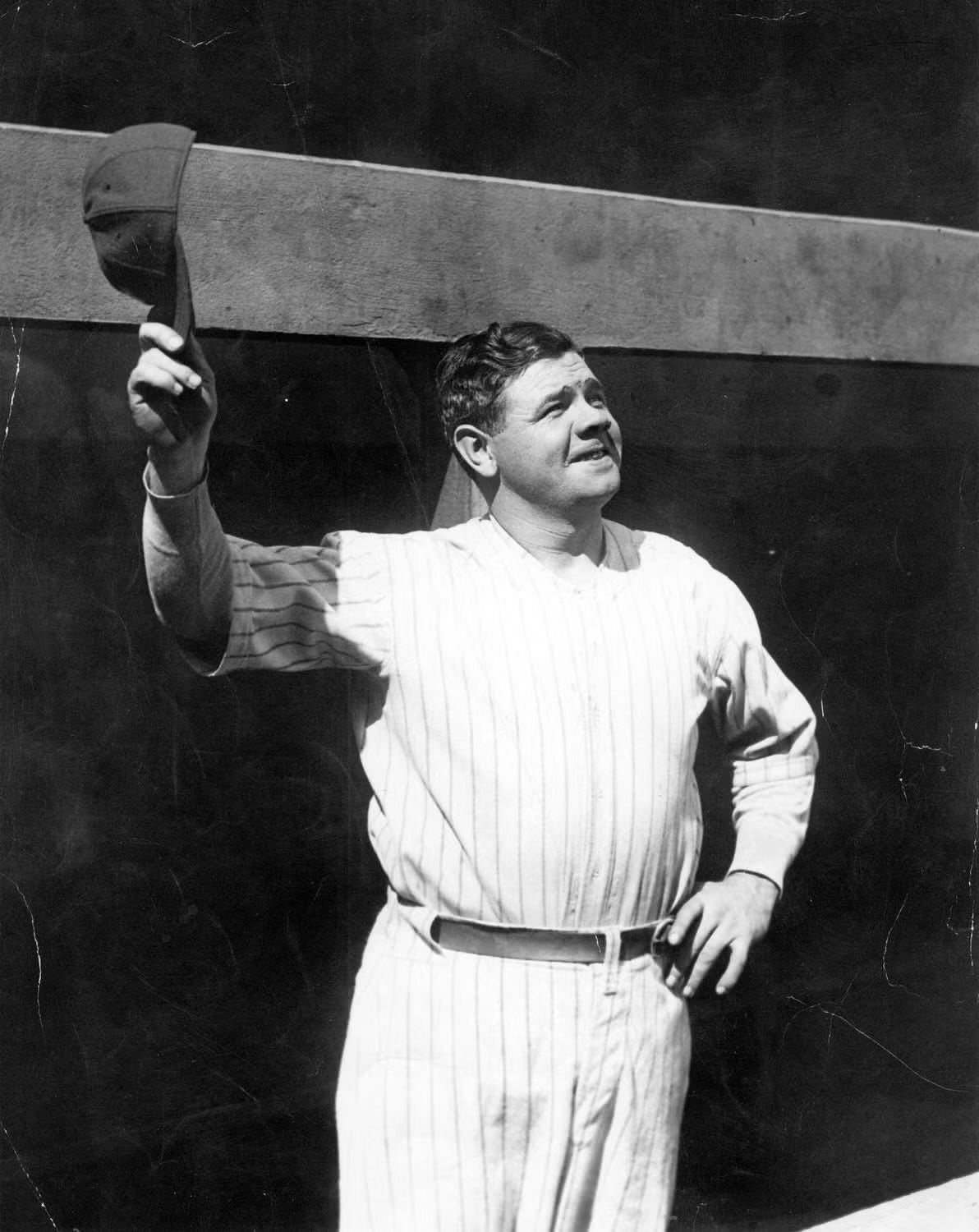
Spent a lot of time at the Babe Ruth exhibit. I had no idea Ruth never played with the Yankees logo on his home uniform. The interlocking NY on the uniform chest debuted in 1936. The Babe retired in 1935. And if seeing Ruth’s jersey, cap, bat and glove weren’t enough, also on display is his Ebonite bowling ball and a Spalding golf ball he used for a 220-yard hole-in-one four years after he retired at a country club on Long Island. That was enough, thank you, to save me a trip to Arlington, Texas, and Pinehurst, North Carolina, to the bowling and golf Hall of Fame respectively.
And more and more. Harry Caray’s eyeglasses; Joe Pepitone’s bat that Mickey Mantle used for his 500th career home run and the one Mick borrowed from teammate Loren Babe in 1953 to hit a 565 foot home run in Washington, arguably the longest ever; Bill Mazeroski’s batting helmet he wore and then waved while circling the bases after the only World Series Game 7 walk-off home run in 1960. It rested in the same display case as the rosin bag Yankees pitcher Ralph Terry used right before he coughed up the Maz home run. The San Diego’s Chicken outfit is there; a whole section of baseball cards through the decades with a banner aptly tagged ‘The Cards Your Mother Threw Away.’ A ticket booth from the old Yankee Stadium; a movie theater with a short feature that plays hourly and a special kids’ section to introduce them to past heroes.
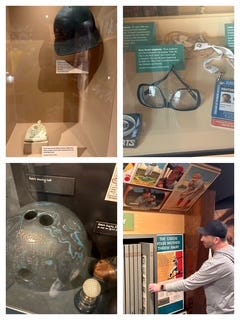
There were hundreds and hundreds of display cases with trinkets from the great history of the game. If you were a baseball fan in 1983 and someone said ‘pine tar’ to you, immediately George Brett’s bat comes top of mind. The bat he used to hit a two-run home run on July 24, 1983 in the top of the ninth to take the lead over the Yankees. Yankees manager Billy Martin protested there was too much pine tar on the bat. Eighteen inches of pine tar on the stick was legal; it was determined there were 23 on Brett’s bat. The home run was nullified. Anyone who saw it will never forget Brett’s reaction charging out of the dugout like a madman to confront umpire Tim McClelland. Go ahead and Google the video. What I never knew, until our tour guide David told us, was there was no competitive advantage at all on how much of the sticky stuff was on the bat. It was too far down the bat to help the grip and the last thing you want as a hitter is the ball sticking to the bat. Instead, it was a baseball economic decision: MLB didn’t want balls defaced by excessive pine tar so they could keep them in play and save money, thus the restriction on how far down the bat the substance could be applied. In today’s game, whenever a ball hits the dirt, fair or foul, it’s tossed out of play, pine tar or none.
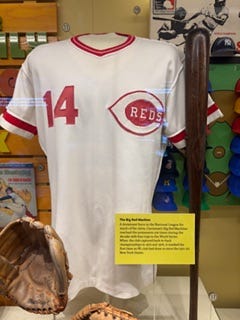
Pete Rose’s uniform is on display as are his caps and gloves. Everything but what he coveted the most—a HOF plaque. Of course, Rose was banned from the game for gambling. Hell, he gambled on his own team to win which sure beats betting the other way. Rose was declared ineligible for induction from 1989 until 2024 when the ban was lifted because he died. Laughably the baseball powers-to-be decided he was no longer a threat to the game which actually he never was. Rose was not my favorite person. I had a couple of encounters with him in the 1970s that weren’t really pleasant but he was the best pure hitter baseball I’ve ever seen. Now that the ban has been lifted, I hope he will tell them from the grave to go to hell if his name ever does appear on the ballot. Pete Rose never cheated the game— his talent and enthusiasm was pure. Pitcher Gaylord Perry cheated the game. He made a living by throwing a spitball, which has been illegal since 1920. No matter. His plaque was hung in Cooperstown in 1991.
Also missing, in my book, are HOF plaques for Thurman Munson, whose life was cut short by an airplane accident in 1979. He played for 11 years with the Yankees. He was a seven-time all-star as a catcher and team captain for two World Championships. His contemporaries of his day, Johnny Bench and Carlton Fisk, are both in. So should Munson. I can also make a case for Maury Wills, the great Dodger of the early 1960’s whose speed changed the game forever. There is a pair of Wills’ cleats on display but that’s not enough, he deserves a plaque. And how Don Mattingly, a .307 career hitter for the Yankees over 13 seasons who led the American League in hits twice and as nine-time Gold Glover was one of the best defensive first baseman in history is not in, I need help with that one. Mattingly represented the game and the Yankees with class during a down time for the New York club. He is a statesman and an ambassador of the sport if there ever was one. Today Mattingly is the field manager of the Phillies. He deserves to be on the wall.
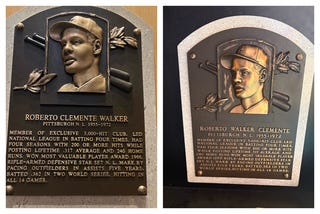
The flip side is of the 354 inductees, only one has two plaques and that just happens to be my favorite player as a kid— Roberto Clemente. In 1972 just months after the Pirates great got his 3,000th career hit, he was killed in an airplane crash on a relief trip to Nicaragua bringing supplies to earthquake victims. By special accord, Clemente was inducted into the Hall of Fame six months later. His Cooperstown plaque originally read ‘Roberto Walker Clemente.’ Twenty-seven years later, in 2000, someone in his extended family realized the plaque was wrong, it should have read ‘Roberto Clemente Walker’ to reflect the Latino culture in which a man uses his mother’s maiden name after his surname. The change was made but the original plaque wasn’t tossed. Instead, it now hangs in the kids’ section—thus the Puerto Rican legend is the only two-plaque inductee in Cooperstown.
And there’s more, so much more. Special displays dedicated to the Japanese impact; history of baseball in Latin America; the women of the game; the legendary Black baseball history and a favorite of mine—the writers’ and broadcasters’ section. So much to take in, so much to digest. To me the one obvious area missing was the history of old ballparks, something I always find nostalgic and fascinating. However, the most stunning tidbit our guide told us is that only 10-12% of the artifacts in the Museum are actually on display. The rest are kept in storage in the sealed off floors below. If you have been to the Hall, you can just imagine the magnitude of that statistic. Museum curators on a regular basis rotate the artifacts, which means the next visit you make to the Hall most likely will include memorabilia not on display the previous visit.
Was four hours enough? Probably for now. Might go back one day to see what I missed. But there’s no way I’ll ever go to Cooperstown again without a room at The Otesaga. That wasn’t a home run. It was a grand slam. Pete would have liked it.

I’m proud that Medjet is sponsoring Sunday Morning Coffee. I spent 20 wonderful years with Medjet in Birmingham, Alabama, and can tell you unequivocally they are the standard-bearer for medical assistance membership programs. A talented staff, who cares about its members, is at the forefront of the company’s success. Whether you are traveling for business or pleasure, domestic or international, a Medjet membership should be an important part of your travel portfolio before you leave home. Check out the Medjet website at medjet.com or just tap on the Medjet logo and you’ll be able to get a look at Medjet’s services, rules and regulations, pricing, and an overview of the organization. And remember, any opinions expressed in Sunday Morning Coffee content or comments belong to the author and not the sponsor. Safe travels with your Medjet membership! — Roy Berger
My law review published an article on the pine tar. I’ll try and find it for you. It’s very clever.
Roy, Thanks for the tour of the Hall, and I didn't have to pay $300. I've been there three times, and I feel I see new things there all the time. Joy and I hope to make another visit there this summer.